Thursday, June 23, 2011

J'ai Fait les Tresses (I Got My Hair Braided)

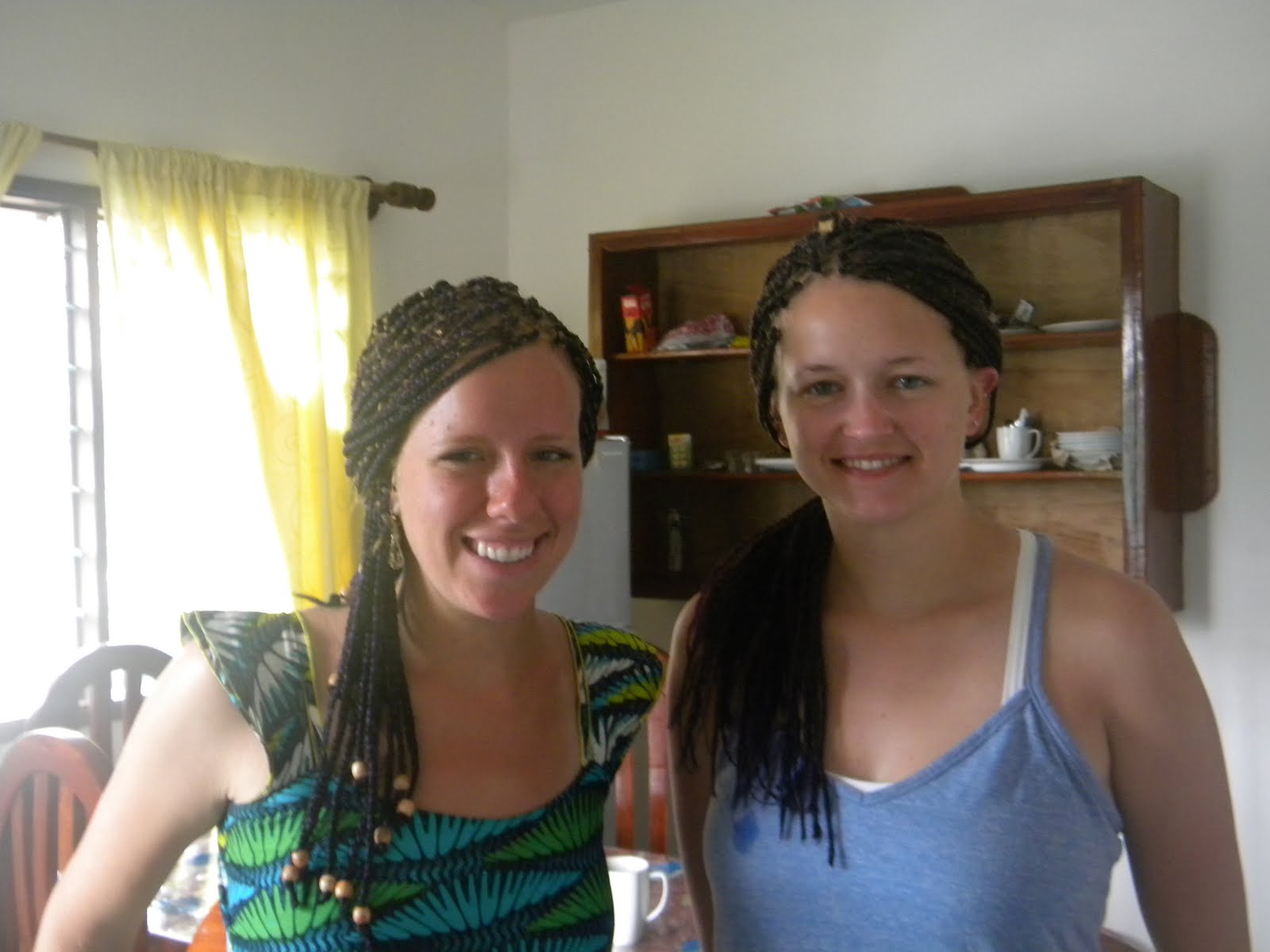
I have survived a strange and terrible initiation into the world of African females- I got my hair braided with extensions.
Even though I grew up in a variety of African countries, I had never gotten my hair braided before because a. I had heard it was painful, b. it's really time-consuming, and c. it always seemed too touristy. But last week I was finally convinced it would be a good idea, so my roommate, Natalie, and I decided to get it done.

Last Friday was a rainy, do-nothing sort of day, so Natalie and I mustered up all our bravery and walked down the street to “La Puissance Divine d'Amour Tresseur”- The Divine Power of Love Hair Salon- where we spent the next 6 hours in excruciating pain. If you've never been through this process, but want to have an idea of how it feels, take a small section of your hair, about a centimeter in diameter, and then yank on it as hard as possible, until it feels like you're going to remove it from your scalp. Keep pulling on it for about a minute, maintaining that same level of force, and then select a section of hair next to it that's the same size and repeat that same action on it. Continue this systematically until you've done it to all your hair, which should take you about 5 or 6 hours. And make sure you stay in the same chair the entire time, and try not to move around too much. By the end you should have a headache, your scalp and your butt should be incredibly sore, you should be somewhat dehydrated, you should be exhausted, and you may want to cry. And while you're doing it, remind yourself that there are countless women all over Africa voluntarily submitting themselves to a similar torture for the sake of fashion.

After the braids were finished the pain faded pretty quickly, and I had to admit I liked the feeling of not having to worry about my hair. This was fairly unfortunate, because since we had gotten our hair done in twists instead of standard braids, and my hair is so short and smooth, and the hair dressers hadn't done a very good job, it started coming out of the twists the next day. By Sunday it was looking pretty bad, and Natalie's was too, so we removed the extensions, and a couple days later we decided we enjoyed having the extensions so much that we would go through the entire process again, but getting normal braids this time, and having someone else do a better job. Round two was much more pleasant, since not only did the hair dresser actually came to our house, but she didn't handle our scalps so brutally.

So now I have black and purple braids, and while I prefer the look of my natural hair, this is still pretty fun, and I don't have to worry about how it looks when I get up in the morning, after I ride a moto/scooter, when I get caught in the rain, etc.I keep getting comments about how beautiful and Béninois my hair looks, so maybe I was wrong about it being touristy. But my suspicions about it being painful and time-consuming were definitely accurate.

Looking as Béninoise as possible with my dress and hair:

Natalie, my fellow braid veteran, and me:
Monday, June 20, 2011

Being white in Bénin

After being in Ouidah for almost 5 weeks, I don't get stared at as much now that my novelty has worn off. Or at least I don't notice it at much. Or maybe everyone has gotten more discreet with their staring. Whatever it is, I'm starting to feel like an integrated member of society, which is a pleasant change. In reality, I probably feel more integrated than I actually am, because, as strange as this might sound, I get so used to always seeing black people that sometimes I forget I'm not black. But the kids on the street frequently give me a reality check by waving excitedly at me and calling out, “Yovo!”, which means white person, to get my attention. But even though I'm white, every time I see white people around town, which is a rare occurrence, I'm always so startled by how different they look in comparison to the people I'm surrounded by that I can understand why the locals stare.

One afternoon during my second week here I was at the cybercafe when I saw a white woman getting out of her car across the street. It had been a few days since I had seen ant yovos, and I was intrigued by her brisk movements as she swiftly opened and closed car doors, rearranged what was inside, and dashed off down the street. It was such a contrast to the methodical, unhurried movements of most Béninois that I couldn't help but join the Africans around me in the activity of staring at her, completely fascinated. My initial reaction to her was one of slight contempt, wondering who she thought she was and what she had to do here in Ouidah that was urgent and important enough to make her so rushed, but then I reminded myself that that's just how it is in many western countries, and that my behavior is very similar when I'm in America. Always rushed, always in a hurry to get to the next event, a mindset which affects even the subtle details of our lives, such as mannerisms and body language. But does anyone actually get more accomplished? Maybe, maybe not; it probably depends on the person.

All that to say, it's more than just skin color that makes foreigners stand out around here, but at the same time skin color alone carries a lot of baggage. White people are assumed to be either tourists or volunteers of some sort. And while neither of these is inherently bad, there is an underlying tension because many people only come here to either capture Africa in photographs or throw money or advice at a continent that is treated as a country, rather than valuing or understanding the people and culture they are surrounded by. Everyone seems to come here with their own agenda.

Switching subjects to something less philosophical and more photograph-able: the weekend before last we took a tour of Lake Ahémé, which is about 30 minutes from Ouidah, and the source of most of the fish we all enjoy so much around here. There are islands scattered throughout the lake where the fishermen/women (fisherpeople?) live, their houses built to the very edge of land. Do they have flooding? Yes. Do they have a flooding problem? Not really, since they've constructed their houses and their lives in such a way that adapts to the changing water level. I saw a group of kids playing football (soccer) and wondered, though, how often they have to retrieve their ball out of the lake.

Next to the lake was an abandoned train station built in 1810, which, when it functioned, used to be where people could catch the train from Lake Ahémé to Cotonou, which is the business capital of Bénin. Now the train station provides convenient housing for squatters.

Thursday, June 16, 2011

Fish, Pineapples, & Daily Marriage Proposals

The other volunteers and I laugh sometimes at how different our lives are in Bénin compared to the countries we normally live in.

Fish
Whenever we go to a restaurant, we can predict the menu. Rice, sauce, and fish. Rice, sauce, and fish. We smile knowingly at each other as the waitress lists the menu items that we could easily list for her. Sometimes a restaurant will surprise us by serving fries or pâte instead of rice. And the type of sauce varies. But there will always be fish. I've actually become addicted to it, and if I go a day or two without these tasty treasures of the sea, I start craving them. And that's after only a month. When I return to the not-coastal-not-fish-infested region of Northern Arizona after eating fish almost every day for two months, there's a chance I might go through withdrawals and start having emotional breakdowns in public. If you're around when this happens, please just feed me some fish, and I'll be fine.
Fish for dinner!


Pineapples

Pineapples have taken on a monetary quality. Example- When I leave the cybercafe and it's hot outside, I ask myself, do I want to take a zem (a moto taxi) and avoid the 15 minute walk home in the heat? “Absolutely not! The cost of that is equivalent to an entire pineapple!”
Or when we're at the one and only supermarket in town contemplating the savory-looking imported boxes of cookies whose names we can't pronounce because they're in Finnish or Dutch and we probably won't enjoy anyway because they're probably dry and flavorless, and we're about to grab a carton, we withdraw our hands thinking, “No, I can't do it! That's 18 pineapples!”
Pineapples hold a very high place in our hearts, in case you couldn't tell.

Marriage Proposals
The questions we get asked when we meet people used to startle us a little, but now we just take them in stride and try to hold back our laughter until afterward.
A typical encounter might go something like this:
Scene: A foreign female, who stands out mainly because of the color of her skin, is minding her own business at a cybercafe, a restaurant, or a variety of other local establishments. A Béninois man, who may be anywhere from 17-40 years of age approaches said foreign female, and begins speaking to her in French.
Béninois man: Hello, how are you?
Foreign female: Hello. I'm fine, thank you.
Béninois man: What is your name?
Foreign female tells him her name.
Béninois man: Are you married?
Foreign female: No.
Béninois man: Would you like to marry a Béninois man?
Foreign female: No, not right now.
Béninois man: Why not?
Foreign female: I have to go back to my country and finish my studies.
The Béninois man seems satisfied that this is a valid reason to not get married at this present time, and eventually leave the foreign female alone.

Occasionally they get more creative, such as the guy who tried to get my phone number a couple weeks ago by telling me he was Barack Obama's brother. When I asked him what he was doing in Bénin if he was Obama's brother, he replied casually that he was just here for the experience of it.

So that's a small taste of life as a Humanity Exchange volunteer in Bénin.

On a side note, I got called a yovo africaine yesterday, which, roughly translated, means a white person who is African. This compliment came while I was eating lunch on the side of the street with my neighbors while wearing my Béninois dress. Being told that made me feel very cool and accepted, which is always a pleasant experience.
Between happy feelings like that and an unending supply of fish and marriage proposals, there is a chance I might stay in Bénin permanently.

Tuesday, June 14, 2011

Nonvitcha

Sunday was the 90th annual Nonvitcha (pronounced No-Veetcha) festival, which celebrates the partnership between two people groups in southern Bénin: the Xwla et Xwéda. Started in 1921, it focuses on their unified historic and artistic values, and embraces economic, social, and cultural development. From what I could tell, they work together throughout the year, and once a year they have their official ceremonies and a giant party, but the other volunteers and I just caught the party end of it. There were thousands of people on the main road and on the beach, street vendors selling food and souvenirs, loud music everywhere, a few concerts going on, and dancing, dancing, and more dancing, because where there is music, there will be dancing. At one point it began raining, and in our mad dash to get out of the rain we, and about 30 other people, accidentally crashed a private party that was inside a gazebo, but we just joined in with their dancing, and they didn't seem to mind us being there.

Any time there's some type of event like this, material is made especially for the occasion, and the majority of the people at the event will be wearing clothes made out of it. This was the design for this year's Nonvitcha:

There was a fun mix of modern and traditional music:

Adding to the atmosphere of excitement was a man painted in the colors of the Béninois flag:
Happy Nonvitcha!

Thursday, June 9, 2011

A Dollar A Day

I live on approximately a dollar a day.

My breakfast of bread and coffee costs $0.25, my lunch costs $0.50, and my dinner can cost from $0.20-$1.00. It's not as if I have the super-power of thriftiness or I'm making an enormous sacrifice of self-deprivation; food is just cheap here, and there's nothing else I need to buy. Oranges are about 10 cents each, mangoes 25 cents, pineapples 20 cents, the list goes on. And it's all unbelievably delicious. (It's also organic, fair trade, and everything else I wish all food in America was.)


There are two main reasons it's so cheap. The first is that it's nearby and grows in abundance, so transportation isn't an issue, and the second is that Benin is such a poor country as a whole that no one would be able to afford the food if it were to cost more. In fact, approximately a third of the country (mainly those in villages) lives under the poverty line, meaning that many of them are also malnourished because they cannot afford to either buy enough food or buy the right food. The dollar I spend on food every day is a luxury for them.

I'm not writing this to evoke emotions of sympathy or guilt. Due to the average cost of food, it would be impossible to live on a dollar a day in most developed countries, even if you wanted to. But there are three things you can do:

1. You can take responsibility for your own consumption and at least be aware of what you're purchasing, what you're eating, and how much of it you're throwing away. Try to buy fair trade items when possible.
2. You can try to help groups that are actively working to make change. For example, check out http://www.kiva.org/, an international organization that facilitates micro-loans in developing areas. By lending $25 (that's the equivalent of about 6 lattes at Starbucks), you can help groups and individuals with projects, such as starting or improving their own businesses, which then allows them to buy food and/or send their children to school.
3. You can get involved in your local community. Volunteer your time at a homeless shelter, food bank, an after school program, etc.

I could end this post with something cliché and inspirational, like, “Be the change you want to see in the world,” but all I really want to say is, if you're already doing something, awesome! Keep up the good work. But if you're not doing anything and you're sitting around watching TV all day, get off your butt and GO DO SOMETHING!!!

Monday, June 6, 2011

Daily Routine

I've been in Ouidah for three weeks now, and have developed a daily routine.
My morning starts off with a baguette and a cup of Nescafe, the baguette I pick up at the bakery down the street, so fresh that its heat makes my fingers uncomfortable. Then I try to be out the door by 8:50 to get to work by 9, but since the word “late” doesn't seem to exist in any African language, I'm not too concerned about arriving exactly at 9. My walk to work is now speckled with familiar faces of people I've walked past at least 3 or 4 times a day since arriving here, and we smile and greet each other. The woman sitting at one of the corners selling bread out of a giant basket, the mechanics discussing how to fix the broken car in front of them, the teenage girls at the hair salon learning how to braid hair professionally. The little kids waving at me excitedly, yelling out, “Yovo, yovo (white person)!”

A typical scene on the way to work:

When I arrive at the VAID office, Rekya, the secretary, greets me in French first, and then we greet each other in Fon, one of the local languages, so I can use the little vocabulary I've acquired since arriving here, and then we greet each other in English, so she can practice what she learned in school. After this fun little exchange, I pull out my computer, and spend the day doing research online for VAID. I have internet access at the office, but it's really slow, so I spend most of my time waiting for the pages to load.

Around lunch time, I walk down the street and either get some fruit or try one of the dishes prepared and sold by one of the women on the side of the street.

In the dishes on this tray are “patte”, a paste made from cassava, and a tomato-based sauce, usually including fish and leafy vegetables in it. The woman selling it carries the entire try on her head from one location to the next, stopping when she reaches a new group of customers. Not only is it incredibly convenient for the customer, who never has to go far to find one of these women, but it's all home-made, and is usually delicious.

I then return to my lethargic internet, and after a few hours, head back home. Not incredibly riveting. But if there's been a lot of rain during the day, the walk home can be very interesting, since sections of my street will be flooded until the water drains off, evaporates, or soaks into the ground. One afternoon, as I was wading past someone's house through six inches of water, trying to keep my skirt up around my knees while not losing my balance on the uneven dirt road full of unexpected potholes, the woman sitting on the porch laughed and told me, “This is Africa”. As if wading through water on my way home was something I frequently did in America, and I had forgotten where I was. I laughed with her, and agreed.

In the evenings I spend time at an orphanage, where I help the kids with their homework. This has been an unexpected challenge, since not only is it usually math, which I haven't done much of in years so I don't remember some of the concepts, but it's in French, which makes it even harder to explain the concepts I can't even remember in English. On top of this, since I haven't done math in French lately, or ever, a lot of the words are unfamiliar to me. As I sat there struggling to explain in French how to calculate the length of a section of carrots when it takes up 35% of Mr. Djaha's garden that has a circumference of 575 meters, I really hoped none of these kids would fail their exams because of me. Thankfully one of the staff members also helps them with their homework, so the fate of their grades isn't solely in my hands.

The wall by the entrance of the orphanage. Roughly translated, it says, "Welcome to the hope of the children of Benin Orphanage":

After leaving the orphanage I have dinner, and the rest of the evening is spent relaxing at home. It's not exactly an action-packed day, but then again, the stress-level that comes with it is pleasantly low.

Friday, June 3, 2011

Thoughts on NGOs in Bénin

Working with non-governmental organizations (NGOs) during the last two weeks has started to give me a first-hand taste of the frustrations within the field of development.

There are countless NGOs in Bénin: orphanages, micro-loans, health education. The list goes on. The people initiating these groups see needs not being addressed, but they don't always know how to find the solution; there is an abundance of compassion and awareness without adequate education. Many of the NGOs have staff members who are older than I am, who have not even completed high school (the secretary I work with is in her mid twenties but only has her 6th grade certificate). This causes them to struggle with correctly preparing documents, reports, and applications that donors expect to see before granting them funds, which then makes it difficult for them to find financing.

Accompanying this are the incorrect assumptions about how foreign/external funding works. For example, the director of VAID has given me the vague assignment of finding financial partners, but she doesn't understand that most donations reward specific projects and innovative concepts, more than an organization as a whole. Along with this, the vast majority of donors are English-speaking, so if I help VAID submit an application for funding, there won't by anyone to continue the communication process after I leave. And even if I can manage to find them funding for a project right now, what good will that do in the long-term if they're left waiting for the next English-speaking intern to come along? If this pattern continues, their success as an organization will constantly be dependent on factors outside of their control.

Another frustration is that sometimes their goals are unrealistic, and hinder them from setting goals that can actually be accomplished. For example, I help at an orphanage of 45 children where the staff is convinced that they need their own hospital, since they can barely afford to take children to the local one. They have not considered the cost of land, construction, materials, maintenance, medication, and staffing that would be necessary for the creation and upkeep of such a facility. NGOs here have repeatedly seen other groups receive hand outs, so a relationship of dependence on European/American countries is sustained and a simplistic assumption has been perpetuated of there being an ocean of money in the land of white people, and all that needs to be done is to find it. There is a lack of education about the complicated process behind all this, so while my current task at VAID is to find financial partners, my actual goal is to help them set up a realistic and sustainable way of receiving funding.

If you have any experience/ideas about finding local funding in Africa, I would love to here them.